Social media has quietly become the most powerful distribution channel for travel. Reels, Stories, TikToks, Substack posts, and group chats have become the primary way people are discovering new destinations.
But there's a disconnect.
Your thumb stops scrolling over a photo or a trip recap that you'd book in a heartbeat — but then what? You screenshot it, save it, maybe DM the creator, and then go back to the old pattern: open a dozen tabs, try to reverse-engineer the itinerary, and hope you can find something similar.
Social media was built for attention and inspiration, not for actually booking the trip behind the content.
Voyagier exists to close that gap. Our platform is built on people whose published, lived travel experiences offer bookable, commissionable trips for any and all other users; in essence, on Voyagier, creators are able to monetize their travel camera roll.
1. Social media is the top storefront for travel
Travel largely starts with inspiration. Most people know they want to get away, but are looking for something that moves them to inspire where and what that should be.
For me — these are internal visualizations where I imagine myself on a trip. It could be something as simple as seeing a reel of drinking a cup of coffee at a cafe on a busy street in Paris, a "Finding Nemo" scuba moment underwater in Indonesia, or losing track of a pair of shoes at the Taj Mahal. At Voyagier, we call these moments "Anchor Points." And it is my theory that these are the moments that keep us engaged in wanting to explore more of our world.
For you — it could be a Patagonia trekking video, a Kyoto food crawl, a perfect long weekend in Lisbon, and through your social discovery of those moments, you start to envision yourself in that scene.
That moment, when the traveler moves from inspiration to initiation, is pure commercial intent. And almost every social platform wastes it.
Traditional social platforms struggle to handle dynamic inventory, live pricing, or complex multi-supplier bookings. They're optimized to keep you scrolling, not to help you move from inspiration to execution.
So the work gets pushed back onto the traveler. And we all know the story of what happens next:
Scroll → Screenshot → Search → Rebuild → Book
That's where Voyagier steps in: we are building the bridge between social discovery and executable itineraries.
2. Lived travel experience = credibility
There's a reason people trust visual trip recaps and personal recommendations more than generic OTAs or anonymous review sites: authentic, lived experience is a signal.
If you've actually done the Argentina road trip, eaten empanadas at those restaurants, stayed in that mountain Refugio, and figured out how to handle transfers across Patagonia, you have infinite more credibility than any banner ad or any of those SEO-optimized lists we've all seen.
Voyagier leans into that reality and trades on the power of authenticity.
Voyagier users are real travelers documenting real journeys. They're witnesses to specific, real-world itineraries. When they share their trips in Voyagier, via our Trip Sync, we treat that as high-value data to serve back to all of our users:
- When and where they went
- How they sequenced destinations
- How they allocated budget
- What they repeated, and what they'd change
Once a trip has been published within Voyagier, it becomes accessible for all users within the platform to discover, be inspired, and to eventually book.
3. Verified users, verified trips, verified posts
The phrase "user-generated content" is not specific enough for travel.
Not all content is equal. A random repost of a stock Bali picture is not the same as a verified, structured itinerary that has actually been fully lived and experienced by a real person.
Voyagier is building around two layers of verification:
- Verified users — people whose identities and histories are anchored by real trips run through our Trip Importer and booking engine.
- Verified trips — itineraries backed by actual reservations, dates, and spend.
When someone shares a Voyagier trip, they're not just posting a vibe. They're sharing a structured, executable plan that VIA (the Voyagier Intelligent Agent) can agentically price, adapt, and book.
That structure is what allows us to turn content into commerce without compromising trust.
4. Introducing: The Navigator Program
Within Voyagier, if you've traveled deeply, shared intelligently, and built a track record of useful itineraries, you've earned more than likes. You've earned distribution power.
Voyagier's Navigator Program is our way of recognizing and rewarding that clout.
Navigators are Voyagier users who:
- Share high-quality, structured trips that others can book.
- Build a reputation for specific regions, styles, or niches (e.g., wine trips, family travel, hiking, food-first itineraries).
- Consistently help other travelers cut through marketing noise.
In the Navigator Program, that value is no longer invisible. When someone books a trip through a Navigator's shared itinerary or a unique referral link:
- The trip is priced and executed through VIA within Voyagier.
- The traveler gets a proven, adaptable itinerary.
- The Navigator gets compensated with a set commission.
Under the hood: how Voyagier makes this real
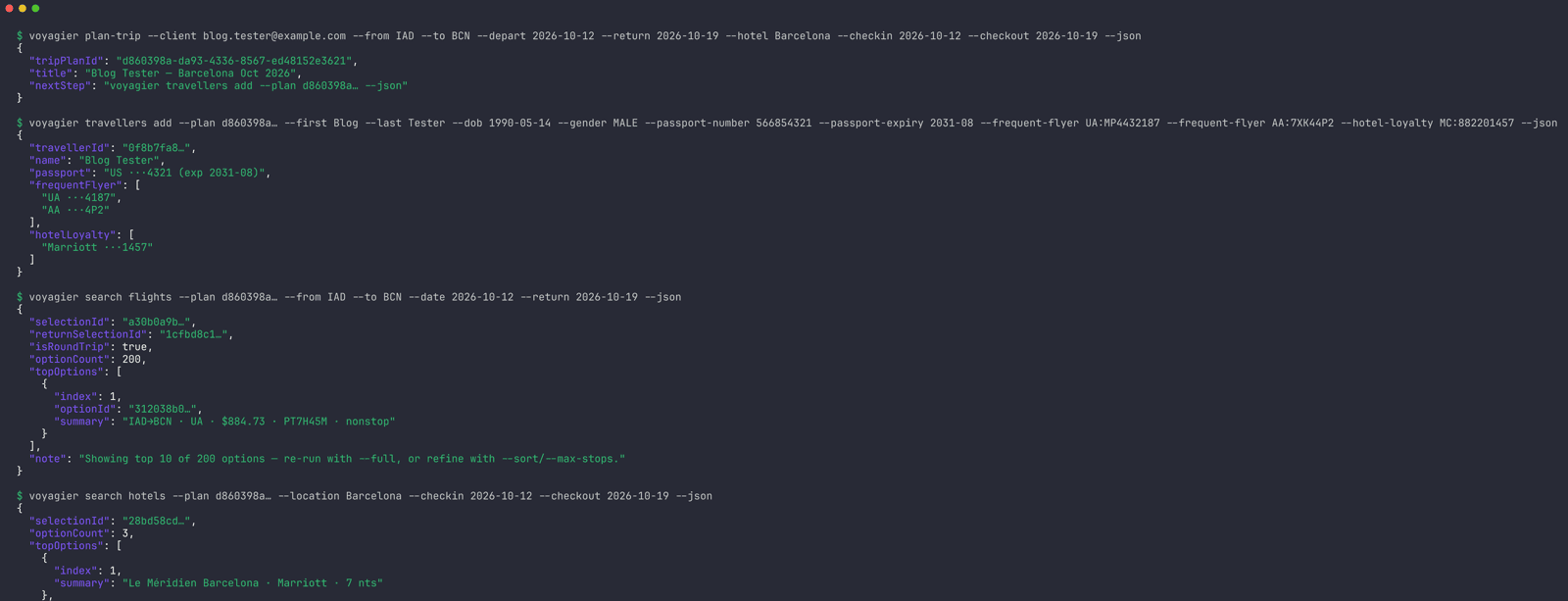
If it sounds too good to be true, rest assured, it's not. Let's break it down. Under the hood, Voyagier combines three pillars:
Trip Sync
Pulls historical trips from your inbox and turns them into structured travel intelligence. This builds your traveler persona and provides the raw material for your sharable itineraries.
Voyagier Intelligent Agent (VIA)
Our booking engine API plus Model Context Protocol layer. VIA understands the structure of a trip, connects to available supply, and will price and book it across air, lodging, dining, and experiences with no bias toward any specific vendor.
Sharable Trip Page
Every itinerary on Voyagier is an interactive page that can be shared as a link, embedded in content, or attached to a post. When someone clicks it, they're not looking at a static brochure — they're interacting with a live, bookable trip that VIA can personalize to their dates, budget, and preferences.
This means:
- A Lisbon trip you share in Voyagier can be posted on your blog, social media, or group chat as a single link.
- Anyone who clicks can adapt their own version of your itinerary ("shorten to 5 days," "upgrade lodging," "swap in a day trip to Versailles") and book it.
- You, as the original trip creator, are tracked and compensated via the Navigator Program when bookings happen.
The takeaway
Social platforms continue to be the top spot for reach, inspiration, and conversation. Voyagier takes things one step further to true social commerce, handling the translation from inspiration to transaction. We're leveling up the value of our users' expertise and authenticity, and removing the friction and the gatekeeping.
Travel isn't just something you consume anymore. On Voyagier, it's something where you can naturally, credibly, and passively earn income by simply doing what you were already doing: going, learning, and sharing.